 by
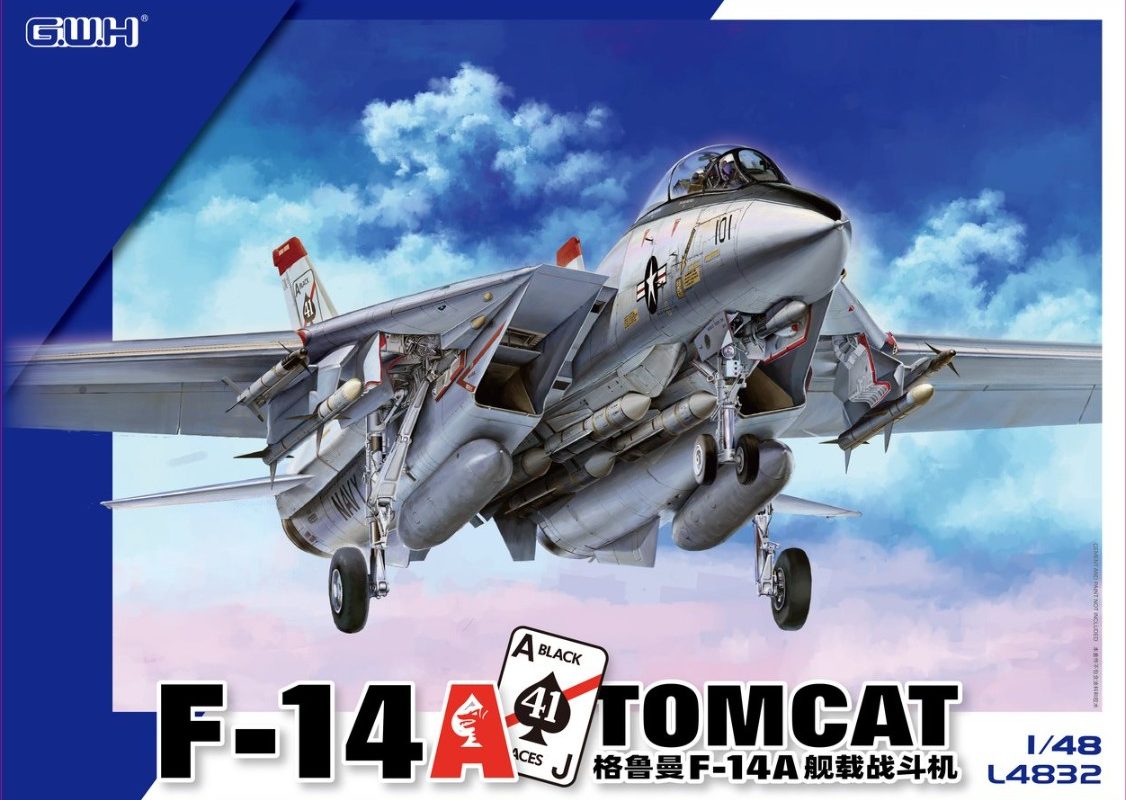
Following up on the massive discussion regarding the arrival of the GWH (Great Wall Hobby) 1/48 Tomcat: I just received my package from the hobby shop yesterday. Here are my raw, “out of the box” findings for this F-14A (ref. L4832).
I won’t go into a full sprue-by-sprue breakdown—there are millions of parts spread across a sea of plastic in an XXL box, typical of the current “gigantism” trend in modern Eastern kits. Instead, these are my immediate impressions based on a close inspection of the sprues, specifically compared to the Tamiya “Full Options” kit (ref. 61112), which sits at a similar price point.
The Good Surprises (The Pros):
- Surface Detail: Very crisp and fine engraving, with a more comprehensive riveting pattern than Tamiya => Advantage: GWH.
- Wings: Can be positioned at maximum sweep or fully deployed. In the deployed position, the spoilers can be shown extended => Advantage: GWH (pending actual fit during assembly).
- Wing Sweep Bags: The inflatable aerodynamic seals are molded with fairly realistic creases in the deflated position (slightly less so in the inflated position) => Advantage: GWH.
- Wing Glove “Turtle Back”: Two options provided depending on wing position, allowing it to be shown slightly open when wings are at max sweep. A first for any Tomcat kit => Advantage: GWH.
- Navigation Lights: Transparent parts are provided for the lights above and below the wing gloves => Advantage: GWH.
- Detailed Joint: Finely molded details with photo-etched (PE) parts to be added at the joint between the turtle back and the wing => Advantage: GWH.
- Landing Gear: As hoped, the struts and wheel wells are highly detailed with multi-part assemblies and numerous separately molded pipes/hoses => Clear Advantage: GWH.
- Wheels: Separate tires and hubs. The tires are one-piece and feature a subtle “weighted” effect. Hubs are sharply molded => Advantage: GWH (if fit is good).
- Cockpit: Well-appointed instrument panels, side consoles, and coamings. Ejection seats feature separately molded harnesses—a very original and detailed touch. The cockpit sills and rear decking are also very nice => Advantage: GWH.
- Access Ladder: The ladder bay is more detailed than Tamiya’s (though still not perfect). The option to show the ladder open but stowed is an interesting touch often seen on parked aircraft => Advantage: GWH.
- Intake Ramps: Moving ramps are significantly more detailed than Tamiya’s, including all the relevant actuators => Advantage: GWH.
- Engine Shrouds: Separate parts are provided to represent the differences between the TF30 and F110 engines.
- Speed Brakes: Can be positioned open and are well-detailed internally => Advantage: GWH.
- TF30 Nozzles: Full of external detail, with more contrast than Tamiya’s. Should look great under paint => Advantage: GWH.
- ECS Vents: Located between the intakes and the fuselage; these feature a fan at the bottom of the housing with a PE mesh overlay => Advantage: GWH.
- Sparrow Bays: The belly recesses for the Sparrow missiles are more detailed than Tamiya’s => Advantage: GWH.
- Phoenix Pallets: Loaded with detail on the sides and rear => Advantage: GWH.
- Canopy: The clear part is separate from the frame, which may facilitate painting (though assembly fit remains to be seen) => Undecided.
- Radome: Can be positioned open with a full radar unit (including PE details) => Advantage: GWH (for those who like to show “everything open”).
- Interior Fuselage: The inner faces of the forward fuselage and spine are full of pre-cut marks for various removable panels and access hatches—a plus for the “engines out” crowd.
The Disappointments (The Cons):
- Gun Port: The fairing around the gun muzzle looks a bit too thin => Advantage: Tamiya.
- Gun Vents: Only “Mid” (2-grille) and “Late” (NACA style) versions are provided; there is no “Early” (7-grille) version => Advantage: Tamiya.
- AoA Probe: The nose probe is provided as a standard plastic part, with no option for an “Early” tip without the probe.
- Step Reinforcement: A stiffener plate is molded in relief around the rear boarding step; this needs to be sanded off except for late-model “Bombcats.”
- Grilles and Meshes: The meshes on the nose gear doors, at the base of the vertical stabs, and along the spine are quite rudimentary => Slight Advantage: Tamiya (though these should be replaced with PE regardless).
- Gear Doors: No option for the left nose gear door with the ALR-50 ECM antenna for late-model Bombcats => Advantage: Tamiya.
- Wing Glove Antennae: While the ALQ-126 bumps are provided as optional parts, the wing gloves themselves are molded with the AN/ALR-45 antenna bumps on the forward sides. These were only applicable after the Block 135 retrofit and must be removed in most cases => Advantage: Tamiya.
- GPS Dome: A GPS antenna option for the spine is included, but it looks undersized => Advantage: Tamiya.
- Spine Antenna: The forward antenna is only provided in the long version (APX-72); it must be cut to the correct length for an older IFF version => Advantage: Tamiya (which provides both options).
- Intake Trunks: The air ducts narrow down after the moving ramps to meet a small-diameter “trompe-l’œil” engine compressor face. Some might not mind, but I dislike it => Advantage: Tamiya.
- Afterburners: Similarly, the burner cans are even more conical than Tamiya’s and are molded in two halves (hello, seam lines!) => Advantage: Tamiya.
- Exhaust Installation: Installing the TF30 nozzles requires some slight “surgery” on the beaver tail (fairly well described in the instructions).
- Vertical Stabilizers: Choice of two types (with or without inverted L-shaped stiffeners). The versions without stiffeners feature the small hexagonal panels, but only as engraved lines when they should be slightly raised. The surface texture is also rougher than the rest of the fuselage => Advantage: Tamiya.
- Chin Pods: Only the TCS (with or without optics) is provided. The aerodynamic fairing for the optics-off version looks too blunt. For an aircraft with only the AN/ALQ-100 (historically very common), you’ll need to raid the spares box or go aftermarket. No early IRST pod either => Advantage: Tamiya.
- Wheels: Only Type II and Type III wheels are included. For “Early” wheels, you’ll need the spares box or aftermarket parts.
- Ventral Fins: The NACA scoops on the ventral fins lack depth.
- AIM-54 Phoenix: Provided only as the “A” version with the four gyroscope bumps => Advantage: Tamiya.
- Ordnance: No Bombcat weaponry, no bomb racks for the Phoenix pallets, and no LANTIRN pod => Advantage: Tamiya.
- Wing Glove Pylons: No option for dual Sidewinder rails. You are limited to a Phoenix/Sidewinder or Sparrow/Sidewinder mix => Advantage: Tamiya.
- Fuel Tanks: The external tanks look too “fat” at the rear, and the separate end caps are only the “Late” type (flat rear face) => Advantage: Tamiya.
- TARPS Pod: The clear sprue includes windows for a TARPS pod, and the block-off plate for the ventral Sparrow station is included, but the pod itself is missing. Strange.
- Windshield: Molded as a single piece with a portion of the fuselage (a good point), but the framing lines seem wrong (too convergent towards the front) => Advantage: Tamiya.
- Canopy Interior: No real improvement on the internal details of the tilting canopy; the defogging ducts are still missing, for example => Draw.
- Beaver Tail: Lack of modularity, same as Tamiya. You’ll have to cut it up for an “Early” Block with the “pancake” style tail.
- Formation Lights (Slime Lights): The lights on the nose and rear fuselage are provided as PE parts to be fitted into recessed slots. Unnecessarily complicated, where a good engraving would have sufficed. Better treatment of the fuselage grilles would have been preferred => Advantage: Tamiya.
The Downright Annoying Blunders:
- Gun Vents: The “Mid” version (2-grille) is provided via a part that still features the “shark gill” gas vents from the Late (NACA) version! You’ll have to fill them or replace the whole thing (keeping in mind that the grilles are slightly undersized anyway, matching the too-small gun muzzle fairing).
- Beaver Tail: It is molded entirely as the version with the ALR-67 ECM fairing, but it’s missing the rounded tip! It just looks messy.
- Sidewinder Rails: Only two are provided, and they are the very late LAU-138 BOL version. To make matters worse, there’s a strange raised ring on the LN2 bottle at the front. There’s no option for an earlier, more common rail—downright infuriating at this price point!
- Sidewinder Missiles: Despite being made of “40,000 parts,” they are ugly with very thick rings. GWH usually delivers much better than this!
- Missile Wells: I haven’t checked the Sparrows yet, but there is a gaping hole at the bottom of the forward ventral recesses to allow for the Phoenix pallets. Why didn’t they let the modeler drill these holes themselves? It’s a nightmare to fill cleanly if you choose not to mount any missiles.
Final Verdict:
This kit is designed to impress “at first glance” with its beautiful engraving and billions of parts—some of which are genuinely superior to Tamiya…
However, it suffers from a lack of consistency and a messy attention to detail regarding the successive generations of equipment. I’m still scratching my head trying to figure out exactly which version you can actually build using only what’s in the box. At this price, and with such high molding ambitions, having to rely on the spares box or aftermarket parts is hard to swallow!
Bottom line:
If you already have the Tamiya “Late” kit in your stash, this GWH only offers real improvements in the wheel wells/landing gear, the cockpit, the intakes, and to a lesser extent, the wing spoilers and some surface details. It’s up to you to decide if the price difference is worth it. I haven’t tested the fit or assembly yet, but I’ll be starting the build soon… as soon as I solve the livery dilemma!
The Arrowhead